Why Data Security Requires a Fresh Approach in 2026
For modern organisations, data is one of their most valuable assets, that supports day-to-day operations, decision-making, and customer experiences.
As organisations continue adopting cloud platforms, Software as a Service (SaaS) applications, and AI-driven technologies, the volume of data being created, shared, and stored continues to grow.
However this increasing reliance on digital ecosystems has introduced new difficulties and challenges.
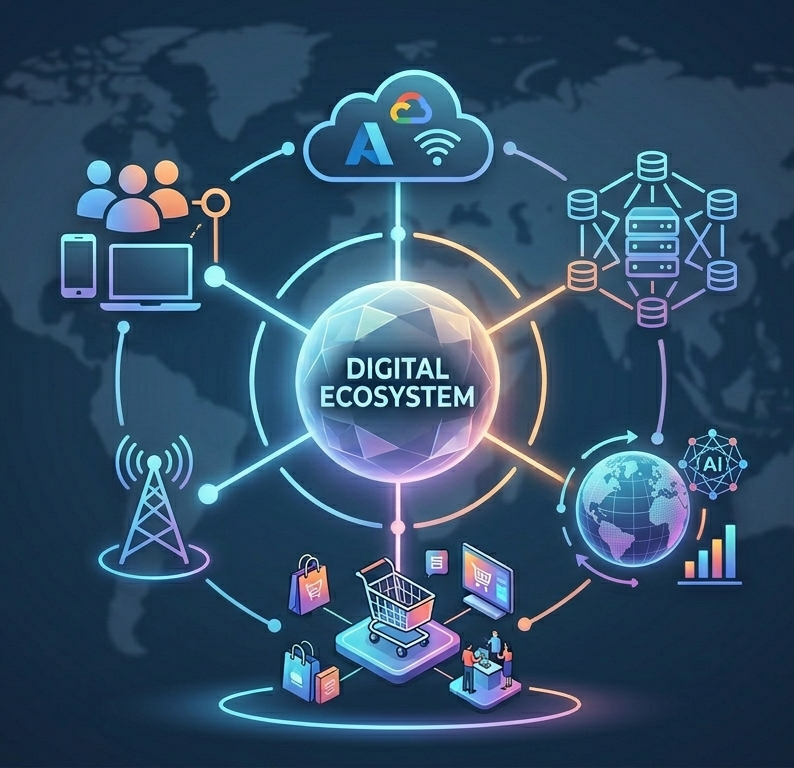
Many organisations continue to face limited visibility into where sensitive data resides, fragmented security controls, and increasingly complex IT environments.
As a result, data leakage is therefore no longer restricted to conventional cyberattacks. Misconfigurations, human error, excessive user permissions, and uncontrolled data movement across cloud and SaaS environments have become equally significant sources of data exposure.
Without stronger visibility and governance, organisations risk:
- Data breaches and financial losses
- Compliance and regulatory challenges
- Operational disruption and reputational damage
To remain resilient in 2026, organisations need a more proactive and data-centric security strategy that goes beyond responding to incidents after they occur.
Understanding where sensitive data resides, how it moves across environments, and who has access to it is now fundamental to reducing risk and strengthening overall security posture.
So where is your business data most likely to leak in 2026?
At LGA, we frequently work with organisations that struggle with limited visibility across cloud, SaaS, AI, and endpoint environments, making it difficult to identify data exposure before it becomes a security incident.
Understanding the most common sources of data exposure is the first step towards improving visibility, reducing risk, and protecting your organisation’s critical information.
4 Key Areas Where Data Leakage Is Most Likely to Occur
Data breaches rarely result from a single point of failure.
Instead, they often stem from limited visibility, inconsistent security controls, and gaps in governance across modern IT environments.
As organisations adopt cloud services, AI tools, and hybrid work models, sensitive data is constantly being created, shared, and accessed across multiple platforms.
Without a clear understanding of where data resides and how it moves, security risks can easily go unnoticed.

Below are four of the most common areas where businesses are most likely to experience data leakage.
1. SaaS Applications and Cloud Misconfigurations
SaaS platforms and cloud environments are essential to modern business operations, but they also introduce significant data exposure risks.
According to the Cloud Security Alliance (2025), 86% of organisations consider SaaS security a high priority, yet 55% of employees still adopt SaaS applications without security team involvement, creating significant blind spots across the environment.
Common issues include:
- Over-permissioned access controls
- Publicly exposed storage or shared files (DataStackHub, 2026)
- Unsecured third-party integrations
As organisations adopt multiple platforms, maintaining consistent governance becomes increasingly challenging.
DataStackHub (2026) reports that 70% of cloud environments contain at least one publicly exposed resource, and that the average cost of a cloud misconfiguration breach now exceeds $4.3 million.
Security Insight:
Regular audits of SaaS and cloud configurations, and user access permissions help organisations improve visibility, reduce security blind spots, and minimise the risk of unintended data exposure.
2. AI Tools and Uncontrolled Data Usage
The rapid adoption of AI tools has also introduced new and often overlooked data security risks.
As employees increasingly use AI to improve productivity, sensitive business information may be shared with public or unapproved AI platforms without adequate oversight.

Forrester’s 2026 cybersecurity and risk research highlights that agentic AI deployments, where AI systems take autonomous actions within enterprise environments, are now among the most significant emerging threats, with the potential to cause major breaches from within organisations themselves.
Employees may unknowingly expose sensitive data by:
- Entering confidential information into AI prompts
- Using unapproved AI platforms
- Sharing outputs that contain sensitive insights
Without clear governance, organisations may lose visibility into how sensitive data is accessed, processed, and shared.
Research from the Cloud Security Alliance (2025) also found that 56% of employees upload sensitive data to unauthorised SaaS or AI applications, often without sufficient visibility or enforcement from security teams.
Security Insight:
Establishing clear AI usage policies and monitoring AI usage helps organisations reduce unintended data exposure while enabling employees to use AI securely and responsibly.
3. Identity and Access Mismanagement
Identity has become one of the primary targets of modern cyberattacks.
According to Tenfold (2025), 80% of cyberattacks now involve identity-based methods, while 99% of security decision-makers expect to experience an identity-related compromise within the next year.
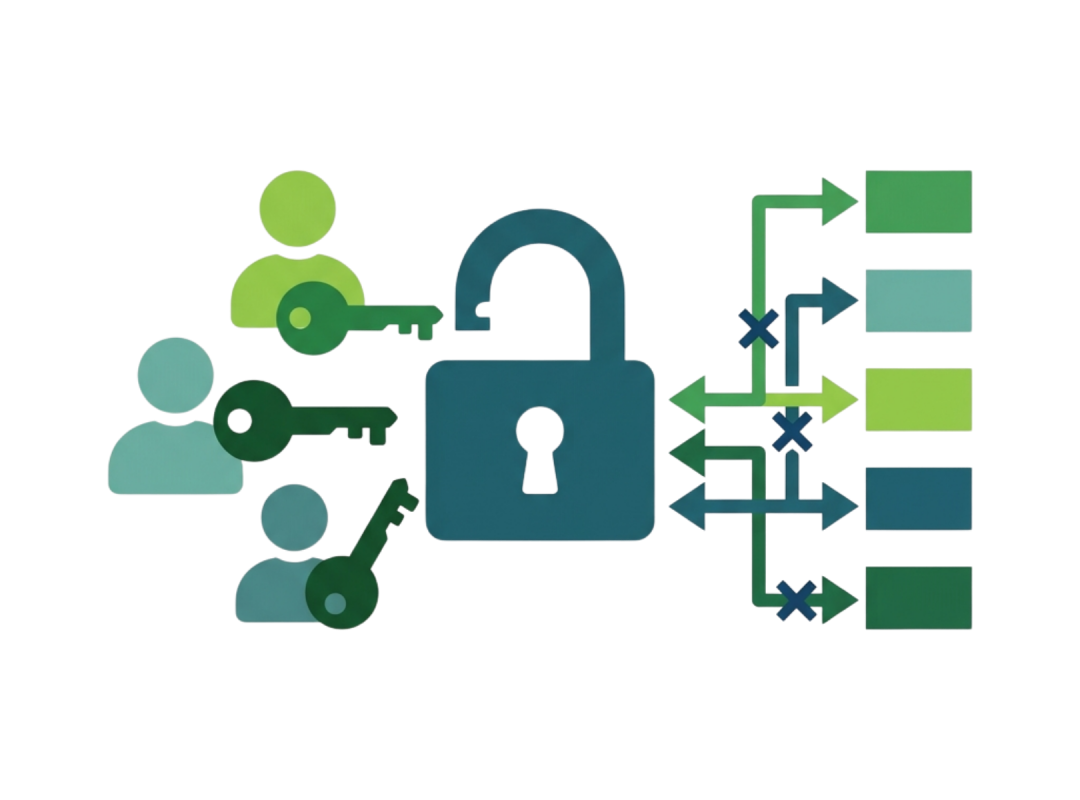
Weak access controls, poor password practices, and misconfigured authentication systems increase the risk of unauthorized access to sensitive business data. Once access is gained, they can move laterally across systems and extract confidential information with minimal detection.
Tenfold’s research also found that over 70% of organizations admit to employees having excessive access privileges or retaining access after leaving the organization, creating a significant and often overlooked source of data exposure.
Security Insight:
Regularly reviewing user access, enforcing least-privilege principles, and strengthening identity and access management (IAM) help reduce unauthorized data access and minimize the risk of data leakage.
4. Collaboration Tools, Endpoints, and Human Error
Everyday tools and user behaviour remain a major source of data leakage (Mimecast, 2026).
According to Mimecast’s State of Human Risk 2026 report, human risk has overtaken technology gaps as the leading cybersecurity challenge for organisations, with insider threats, credential misuse, and human error accounting for most security incidents.

Common risks include:
- Sharing files with incorrect recipients
- Creating unrestricted access links
- Using unsecured personal or remote devices
Mimecast also found that just 8% of employees account for approximately 80% of security incidents, and that collaboration tool attacks are a growing and increasingly costly threat.
As hybrid work continues, sensitive data is increasingly accessed and shared across multiple devices, collaboration platforms, and remote locations, expanding the potential attack surface.
Security Insight:
Strengthening endpoint security, enforcing secure collaboration practices, and improving employee awareness help reduce the risk of accidental data leakage and unauthorized data access.
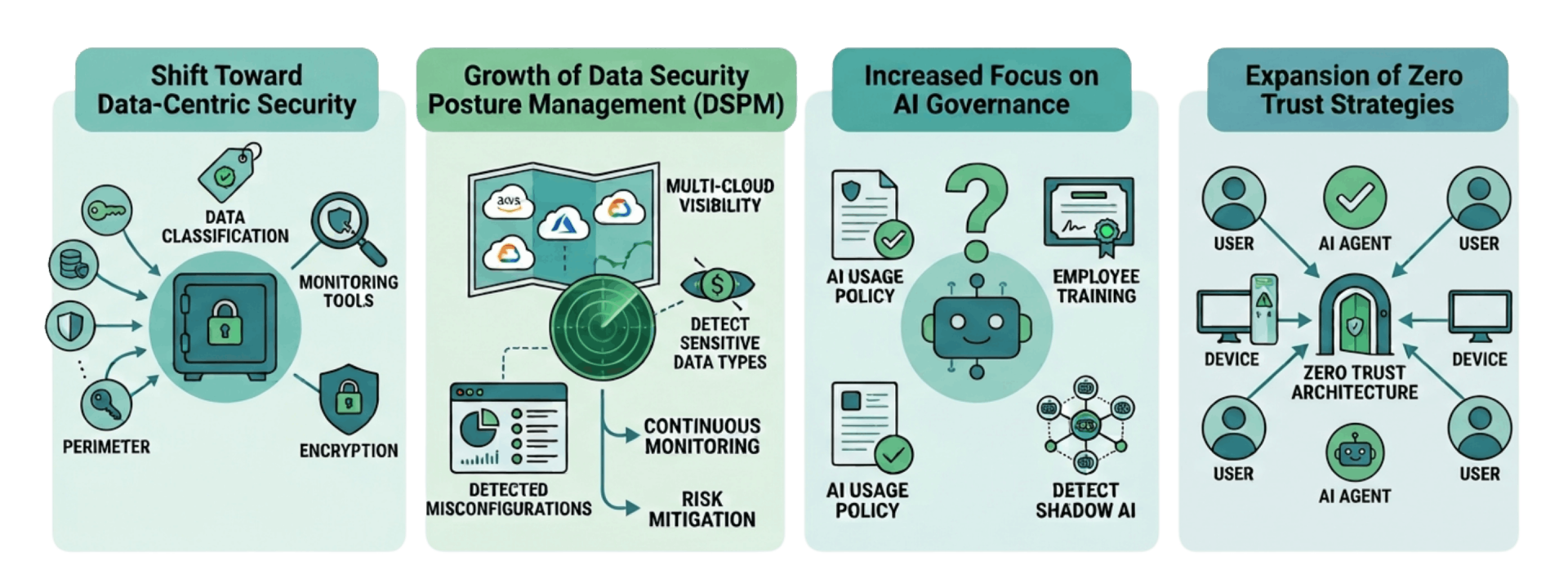
Key Data Security Trends to Watch
1. Shift Toward Data-Centric Security
Organisations are moving beyond traditional perimeter-based security and placing greater emphasis on protecting the data itself. By combining data classification, continuous monitoring, and encryption, businesses can better safeguard sensitive information regardless of where it is stored or accessed.
2. Growth of Data Security Posture Management (DSPM)
As organisations manage growing volumes of data across cloud and SaaS environments, Data Security Posture Management (DSPM) is becoming an essential capability.
DSPM solutions help organisations identify where sensitive data lives, detect misconfiguration risks, and maintain continuous visibility across multi-cloud environments, addressing gaps that traditional security tools often overlook.
3. Increased Focus on AI Governance
As AI adoption accelerates, organisations are introducing stronger governance to ensure sensitive data is used responsibly. This includes formal AI usage policies, employee awareness training, greater visibility into unauthorised or “shadow AI” applications that may expose confidential business information.
4. Expansion of Zero Trust Strategies
Zero Trust is becoming a core component of modern cybersecurity strategies, based on the principle of “never trust, always verify.”
Organisations are increasingly applying Zero Trust across users, devices, applications, and AI-driven workloads to reduce the risk of unauthorised access and data exposure.
According to Tenfold (2025), 87% of organisations have implemented or are actively working towards a Zero Trust security model.
How Organisations Can Reduce Data Leakage Risks
A proactive approach to data security can help organisations reduce exposure, improve visibility, and strengthen cyber resilience across increasingly complex IT environments.
Key actions include:
- Conducting regular SaaS and cloud security audits to identify misconfigurations and over-permissioned access before they become exposure points
- Strengthening identity and access management, this ensures that only the right people have access to the right data, at the right time
- Implementing clear AI governance policies. This sets boundaries on how employees use AI tools and which platforms are approved.
- Securing endpoints and monitoring device activity are particularly important as hybrid work continues to expand the attack surface
By addressing these areas together rather than in isolation, organisations can improve visibility across their environment and build a more resilient security posture.
LGA helps organisations strengthen their data security posture through a range of cybersecurity solutions.
Our Data Loss Prevention (DLP) solution helps prevent sensitive data from being exposed through AI tools, SaaS applications and other data channels.
Complementing this, our 24/7 Security Monitoring continuously detects and responds to threats through our local Security Operations Centre (SOC) team, while our Cloud Anomaly Detection Platform provides deep visibility into cloud workloads to identify suspicious behaviour, detect cloud anomalies, and uncover potential security risks before they escalate.
Conclusion
Data leakage in 2026 is no longer driven solely by external cyberattacks.
As organisations continue to adopt cloud platforms, AI tools, SaaS applications, and hybrid work models, sensitive data is being created, shared, and accessed across more environments than ever before, increasing the risk of unintended exposure.
Understanding where these risks exist is the first step towards strengthening your organisation’s security posture.
By taking a proactive, data-centric approach and addressing key risk areas early, organisations can reduce exposure, strengthen compliance, and protect what matters most – their data.
Looking to strengthen your organisation’s data security?
Explore LGA’s cybersecurity solutions, including Data Loss Prevention (DLP), 24/7 Security Monitoring, and Cloud Anomaly Detection, to help reduce data exposure and improve visibility across your IT environment.
Speak with our cybersecurity specialists today to find the right solution for your organisation.
Protect Your Business Data Before It Becomes a Security Incident
Discover how LGA can help identify data exposure risks and strengthen your security across environments.
References
Cloud Security Alliance, C. S. A. (2025, April 21). State of SaaS Security Report 2025. https://cloudsecurityalliance.org/artifacts/state-of-saas-security-report-2025
David, D. (2026, May 21). 50 Cloud Misconfiguration Statistics For 2025–2026. https://www.datastackhub.com/insights/cloud-misconfiguration-statistics/
Köller, J. (2025). 51 IAM statistics for 2025 | Tenfold.
https://www.tenfold-security.com/en/iam-statistics/
Mimecast. (2026). The State of Human Risk 2026 | Mimecast. https://www.mimecast.com/resources/ebooks/state-of-human-risk/
Schulze, H. (2026, June 10). Forrester 2026 Threat Intelligence Report: AI Agents Top CISO Risk List. https://www.cybersecurity-insiders.com/forrester-top-cybersecurity-threats-2026/