As organisations continue to scale their cloud environments, cloud monitoring in Microsoft Azure & Amazon Web Services (AWS) has become a critical component of modern cybersecurity strategies.
However, many businesses still face a major challenge: limited visibility across their cloud infrastructure.


Without proper visibility, detecting suspicious behaviour in AWS and/or Azure becomes increasingly difficult, allowing threats to remain undetected until it is too late for businesses.
For organisations operating in highly digital regions like Singapore, where cybersecurity risks continue to evolve, improving cloud visibility is no longer optional.
It has become essential for strengthening cloud security posture, improving threat detection, and reducing operational risk.
This is why businesses are increasingly adopting our Cloud Anomaly Detection Platform to improve AWS and/or Azure threat monitoring, strengthen cloud visibility, and detect risks earlier across dynamic cloud environments.
Current Cloud Environments Are Increasingly Difficult to Manage
1. The Business Impact of Limited Cloud Visibility
When organizations lack sufficient visibility in AWS and/or Azure, the consequences extend beyond technical security challenges.
Having limited cloud infrastructure monitoring often leads to delayed incident detection, increased remediation costs, and possible compliance risks.
Threats could also go unnoticed for long stretches of time without real-time cloud monitoring, enabling attackers to continue operating inside cloud settings. This raises the possibility of service interruptions, reputational harm, and data breaches.
For organizations operating in Singapore, where cyber security regulations and data protection expectations continue to tighten, insufficient cloud threat detection can therefore, expose businesses to financial penalties and legal risks (Cyber Security Agency of Singapore, 2025).
This further highlight why improving cloud visibility has become a business-critical priority for organizations looking to strengthen cloud security posture, improve operational resilience and detect threats earlier across cloud environments.
2. Why Traditional Security Tools Fall Short
Traditional security tools were made for on-premises, static situations with distinct network borders.
As cloud resources can modified or decommissioned within minutes, these tools struggle to provide accurate and timely visibility in cloud systems, where resources are ephemeral and network perimeters are fluid (National Institute of Standards and Technology [NIST], n.d.).
As these security solutions also often rely on signature-based detection, static configurations and fixed network perimeters, this creates limitations that restrict real-time visibility across the cloud environments and blind spots for hackers that can exploit.
3. Cloud Environments Face Threats from Multiple Attack Vectors
3.1 Misconfigured Services
Misconfigurations remain one of the leading causes of cloud security incidents. Overly permissive IAM roles, publicly exposed S3 buckets, and unsecured security groups can unintentionally expose sensitive data and critical systems (Check Point Research, 2023).
Without continuous cloud monitoring and configuration visibility, these risks may remain undetected, significantly increasing an organization’s attack surface.
The risk is further amplified by automated deployments, infrastructure-as-code implementations, and frequent cloud configuration changes, which increase the likelihood of human error across cloud environments.
3.2 Compromised Credentials
AWS and Azure environments rely heavily on identity and access management.
If credentials are stolen through phishing, malware, or leaked access keys, attackers can gain legitimate-looking access to cloud resources.
Considering that this activity often appears as a normal user behavior, detecting suspicious behavior in the cloud environments becomes difficult without any behavioral analysis and anomaly-based cloud threat detection.
3.3 Insider-driven Activities
Insider-driven activities can also significantly threaten cloud environments. Risks may include unauthorized access to sensitive data and misuse of privileged accounts, often going undetected by traditional security tools due to the legitimate access of users.
3.4 Unmonitored Outbound Traffic
Many organizations also prioritize inbound threats, which obscure outward traffic. Attackers frequently employ outbound channels to exfiltrate data or communicate with external command-and-control servers.
In the absence of deep visibility into network activity, unmonitored outbound traffic can totally circumvent traditional security measures.
Why Cloud Visibility & Security Are Critical to Your Business
1. Enable Faster Detection and Response
Continuous visibility to your cloud logs helps security teams detect suspicious activity earlier before threats escalate into major incidents.
With real-time visibility into user behaviour, API activity, network traffic and configuration changes, organizations can identify anomalies faster and improve incident response efficiency.

Improved AWS and/or Azure activity monitoring also helps:
- Reduce mean time to respond (MTTR)
- Improve threat investigation workflows
- Strengthen incident response coordination
- Minimize operational disruption
2. Improve Cloud Threat Detection at Scale
As AWS and Azure environments expand across multiple accounts and regions, manual monitoring becomes increasingly difficult.Centralized cloud monitoring provides unified visibility across cloud environments, helping organizations:
- Improve AWS and/or Azure threat detection
- Reduce security blind spots
- Simplify cloud monitoring operations
- Maintain visibility at scale
For organizations with SOC services in Singapore, stronger cloud visibility also improves the effectiveness of their cloud security operations and threat response workflows.
The question many IT leaders are asking is:
How can organizations improve cloud visibility without increasing operational complexity?
LGA’s Cloud Anomaly Detection Platform
LGA’s agentless Cloud Anomaly Detection Platform helps organizations improve real-time visibility across AWS and Azure environments without adding operational complexity.
Built for modern cloud infrastructures, the platform continuously monitors cloud activities, user behavior, configurations, and network traffic across multiple cloud accounts and regions to identify suspicious anomalies earlier.
Unlike traditional security tools, our platform leverages behaviour-based monitoring to detect threats that signature-based solutions may overlook.
Our Cloud Anomaly Detection Platform helps organizations:
- Detect insider-driven threats within cloud environments
- Uncover outbound traffic bypassing traditional security controls
- Audit and validate cloud security posture continuously
1. Detect Insider-Driven Threats Within Cloud Environments
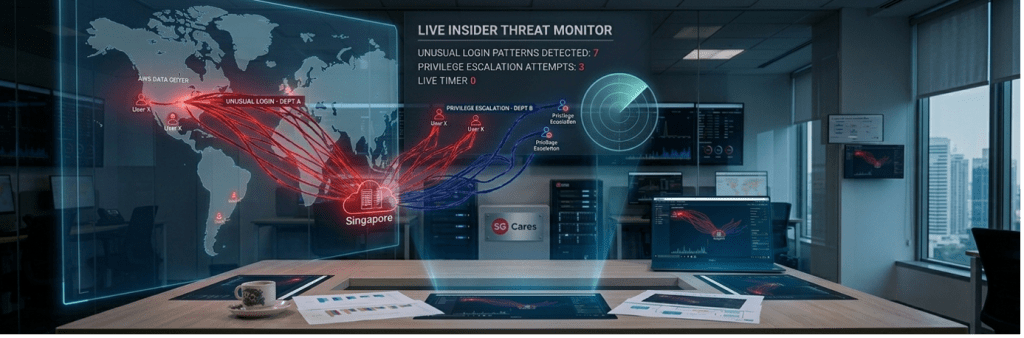
LGA’s Cloud Anomaly Detection Platform uses behavioural analysis to detect suspicious activities such as unusual login behaviour, abnormal privilege escalation, and unexpected access to sensitive AWS and/or Azure resources.
This enables security teams to identify insider-driven threats earlier and respond faster before incidents escalate.
2. Uncover Outbound Traffic That Bypasses Traditional Security Controls
Attackers often exploit outbound traffic channels to exfiltrate data or communicate externally without detection.
Our platform improves outbound traffic visibility by continuously monitoring cloud network activity and identifying suspicious communication patterns across cloud environments.
3. Audit and Validate Security Posture Across Cloud Environments
With us, you can now monitor your cloud infrastructure to identify misconfigurations, validate access controls, and improve cloud security posture visibility.
This helps organizations reduce security risks and strengthen long-term cloud security governance.
With centralized visibility across cloud environments, security teams can now investigate incidents faster, improve threat response workflows, and strengthen cloud security operations more effectively.
How Businesses Are Improving Cloud Security Visibility to Detect Threats Earlier with Our Platform
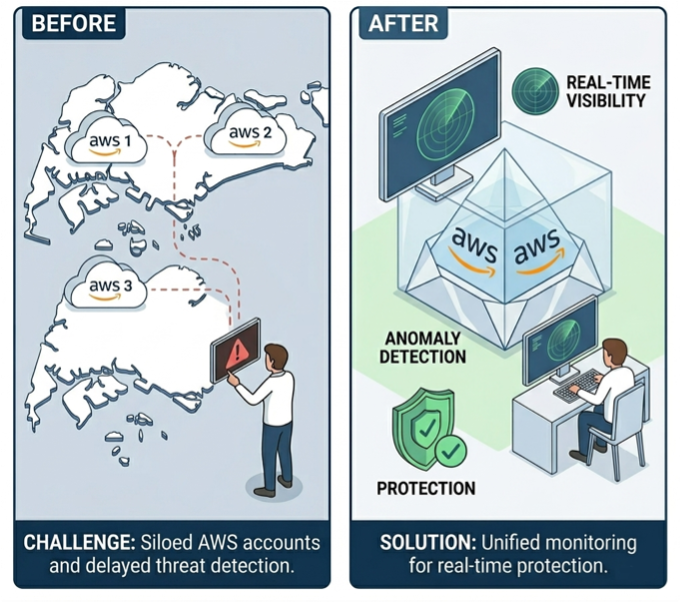
A mid-sized firm operating in Singapore have faced challenges detecting suspicious behaviour across multiple AWS accounts.
Despite using managed cloud security services, the lack of unified visibility resulted in delayed detection of anomalous user access
After implementing our Cloud Anomaly Detection Platform, the organization gained centralized monitoring and real-time behavioural analysis. This enabled their SOC team to detect credential misuse early and prevent potential data exfiltration.
The Growing Need for Continuous Cloud Security Monitoring
As cloud adoption continues to grow, organizations need stronger visibility and smarter threat detection across their compute environments. Improving cloud visibility is no longer just about monitoring.
It is about gaining actionable insights to detect suspicious behaviour earlier, respond faster, and reduce cloud security blind spots before threats escalate.

For businesses in Singapore, investing in cloud monitoring and anomaly detection solutions is becoming essential for strengthening long-term cybersecurity resilience and operational security.
Improve Visibility Across Your Cloud Environment
Strengthen AWS and/or Azure visibility, detect suspicious cloud behaviour earlier and reduce security blind spots with our Cloud Anomaly Detection Platform.
References
Check Point Research. (2023, June 26). Cloud security threats remain rampant: Check Point survey reveals heightened concerns for 76% of organizations amid 48% increase in cloud‑based network attacks. Check Point Software. https://www.checkpoint.com/press-releases/cloud-security-threats-remain-rampant-check-point-survey-reveals-heightened-concerns-for-76-of-organizations-amid-48-increase-in-cloud-based-network-attacks/
Cyber Security Agency of Singapore. (n.d.). Cybersecurity for organisations. https://www.csa.gov.sg/our-programmes/support-for-enterprises/sg-cyber-safe-programme/cybersecurity-resources-for-organisations/
Gartner. (2024, June 5). The expanding enterprise investment in cloud security. Gartner. https://www.gartner.com/en/newsroom/press-releases/2024-06-05-the-expanding-enterprise-investment-in-cloud-security
Microsoft. (2023, December 5). Microsoft Incident Response lessons on preventing cloud identity compromise. Microsoft Security Blog. https://www.microsoft.com/en-us/security/blog/2023/12/05/microsoft-incident-response-lessons-on-preventing-cloud-identity-compromise/
National Institute of Standards and Technology. (2020). Security and privacy controls for information systems and organizations (NIST SP 800-53 Rev. 5). https://doi.org/10.6028/NIST.SP.800-53r5