As logistics companies transform into digitally integrated enterprises, their network infrastructure becomes the backbone of real-time visibility, automation, and supply chain responsiveness.
But this growing reliance on digital platforms introduces a critical risk – network downtime.
In logistic, downtime is not a minor inconvenience. It halts time-sensitive operations, disrupts client commitments, throws delivery schedules off course, and sends ripple effects across the supply chain.
To safeguard against these costly disruptions, forward-looking logistics firms are adopting our Dual Core Solution – a purpose-built solution engineered to eliminate single points of failure and ensure uninterrupted connectivity.
The Downtime Dilemma in Logistics: Hidden Costs, Visible Impact
1. Revenue Loss & Operational Standstill
When your network goes down, your entire logistics operation grinds to a halt. For businesses managing time-sensitive freight, even a brief outage can mean missed cut-off times, costly rescheduling, or SLA penalties from third-party providers.
In high-volume environments like distribution centres and e-commerce fulfillment hubs, every minute counts and the costs add up fast. Downtime can rack up direct revenue losses of US$10,000 to $22,000 per hour (Mainway Handling Systems, 2024).
And that’s just the beginning. Hidden costs compound quickly from:
-
- Overtime labour for recovery
-
- Fuel waste from rerouted vehicles
-
- Urgent rescheduling of deliveries
The impact is not just financial, it undermines trust, disrupts operations, and weakens competitiveness.
2. Erosion of Customer Trust
In logistics, reliability is everything.
When network outages disrupt tracking or delay deliveries, the damage extends beyond inconvenience, it undermines customer confidence. Over time, recurring disruptions can push long-term clients toward competitors.
In sectors like cold-chain logistics or high-value freight, a single missed SLA (Service Level Agreement) can cost millions in lost contracts or compensation claims (Ho, 2024).
Downtime does not just interrupt service, it breaks trust, and trust is what takes years to earn but moments to lose.
3. Supply Chain Ripple Effects
Modern supply chains depend on real-time data and seamless coordination where a single network failure can set off a ripple effect, halting production, breaking vendor schedules, and causing last-mile chaos.
Without up-to-date information, teams cannot adapt quickly, leading to shipment bottlenecks, inventory mix-ups, and avoidable demurrage fees.
Despite common assumptions that such outages are rare, the data tells a different story.
According to Kaspersky’s 2024 research in the figure below, 46% of businesses experience network issues one to three times a month, while 13% are hit by disruptions every week. Only a small minority – just 6%, report problems less than once a year. (Kaspersky, 2024)
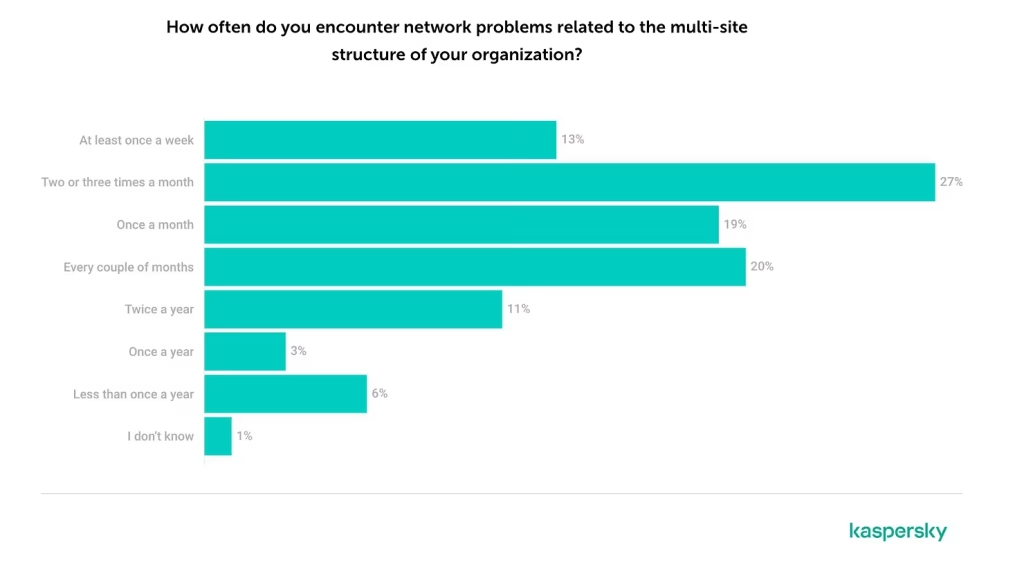
(Kaspersky, 2024)
The financial impact is equally significant.
Supply chain interruptions cost Global 2000 companies more than US$400 billion each year, averaging $200 million per company – about 9% of annual profits. On top of that, each minute of downtime results in an average loss of $9,000, translating to $540,000 for every hour operations are halted (Mohanty et al., 2024).
A Smarter Approach: LGA Dual Core Solution
To mitigate the operational risk of network downtime, LGA delivers a purpose-built solution designed for resilience, scalability, and uninterrupted service.
Specifically engineered to eliminate single points of failure, this solution keeps logistics operations online, even if one telco goes down.
As a telco-neutral setup, it leverages two physically independent internet or intranet lines from separate providers. If Service Provider A experiences an outage, traffic is seamlessly rerouted to Service Provider B – with no manual switchover or IP address change required.
1. Prevent Revenue Loss & Operational Standstill
LGA’s zero-interruption architecture keeps mission-critical systems from TMS and WMS to fleet tracking, online even during a network disruption. With automatic failover, operations continue seamlessly, preventing revenue leakage, shipment backlog, and costly downtime.
2. Uphold Customer Commitments & Trust
With a 99.999% SLA, our solution also helps logistics providers consistently meet delivery timelines and service-level agreements. Constant IP addressing ensures real-time visibility tools, APIs, and customer portals remain functional even during failover, preserving customer confidence.
3. Eliminate Supply Chain Disruptions at the Root
LGA removes single points of failure by leveraging fully independent links from two telco networks. This telco-neutral, dual-path design prevents network failures from cascading across systems, enabling continuous supply chain collaboration and uninterrupted multi-party integrations.
4. Key Features & Benefits
-
- Full Network RedundancyTwo physically separate infrastructures (NGN & non-NGN) ensure true path and exchange diversity.
-
- Seamless Auto-FailoverInstantly switches between telcos with zero service interruption — no manual intervention required.
-
- Static IP PreservationIP addresses remain constant during failover, keeping integrations and third-party systems fully connected.
-
- Scalable BandwidthFlexibly scale network capacity to meet growing operational demands without re-architecting.
-
- 24/7 Line MonitoringReal-time health checks and automated alerts provide complete transparency and rapid fault detection.
-
- Island-Wide CoverageDual-core architecture is supported across Singapore, ensuring resilient connectivity anywhere you operate.
In logistics, speed and reliability aren’t optional – they’re expected. One network outage can damage both.
Logistics Runs on Trust and We Help You Keep It.
Our Dual Core Solution gives you the assurance to operate without fear of downtime, telco failures, or infrastructure breakdowns. It’s how you keep shipments moving, customers satisfied, and operations on track, always.
Get in touch today to schedule a consultation with us!
References
Ho, A. (2024, May 21). How to prevent SLA breaches? A guide for MSPs. Acronis. https://www.acronis.com/en-sg/blog/posts/how-to-prevent-sla-breaches/
Kaspersky. (2024). Geo-distributed businesses: IT security challenges and solutions. Kaspersky Daily. https://www.kaspersky.com/blog/geo-distributed-businesses-research-2024/
Mainway Handling Systems. (2024, July 23). The Cost of Downtime in Warehouse Operations and the Benefits of Preventative Maintenance. LinkedIn. https://www.linkedin.com/pulse/cost-downtime-warehouse-operations-benefits-preventative-033dc/
Mascellino, A. (2024, May 20). Network Outages Hit 59% of Multi-Site Businesses Monthly. Infosecurity Magazine. https://www.infosecurity-magazine.com/news/network-outages-hit-59/
Mohanty, A., Robinson, T., O’Farrell, A. (2024, July 23) The hidden costs of downtime: The $400B problem facing the Global 2000. Oxford Economics. https://www.splunk.com/en_us/pdfs/gated/ebooks/the-hidden-costs-of-downtime.pdf